Aeromonas salmonicida causes furunculosis, a bacterial septicaemia of farmed and wild fish that has been among the most economically damaging diseases in aquaculture. Vaccination is the principal control, and vaccination against it is one of the clearer success stories in animal health — but only where the vaccine reaching the fish is still potent, which is a storage question as much as a manufacturing one.
The pathogen
A. salmonicida is a Gram-negative bacterium, non-motile in its typical subspecies, and it affects salmonids most severely — Atlantic salmon, trout and related species — though atypical strains infect a wide range of other fish including carp and catfish.
Its virulence rests substantially on the A-layer, a paracrystalline surface protein array that resists host complement and phagocytosis. The A-layer is also strongly immunogenic, which is why whole-cell preparations work: the surface antigens that make the organism dangerous are the ones the immune system learns to recognise.
Disease presents as septicaemia with the characteristic skin furuncles that give the condition its name, and mortality in an unprotected population can be severe. Stress, high temperature and crowding all precipitate outbreaks, which is why intensive culture systems are where it matters most.
What an inactivated whole-cell vaccine is
The preparation is straightforward in principle. The bacterium is cultured to high density, then killed — typically with formalin — leaving the cells structurally intact. The result presents the full range of surface antigens without any capacity to replicate or cause disease.
This contrasts with a live attenuated vaccine, which replicates and generally produces stronger and longer immunity but carries reversion risk, and with subunit vaccines, which present purified components and are safer still but often less immunogenic.
For fish, inactivated whole-cell preparations with an oil adjuvant have been the commercial mainstay. The adjuvant is essential: it holds antigen at the injection site for slow release and provokes the local inflammation that drives a strong response. It is also the source of the technique’s main welfare cost, since oil adjuvants cause intra-abdominal adhesions and occasional granulomas.
Why storage decides efficacy
An inactivated vaccine contains no living organism, which leads to an assumption that it is therefore robust. It is not.
The protective antigens are proteins in a defined conformation. Immunity depends on the immune system encountering epitopes with the shape they have on an intact bacterium. Anything that denatures or degrades those proteins reduces potency, and none of it is visible in the vial.
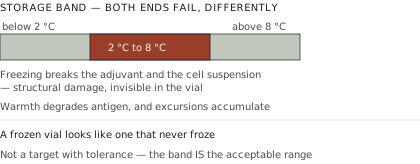
Temperature is the dominant variable. Elevated temperature accelerates protein degradation and, in an emulsion, promotes separation of the phases. Freezing is equally damaging — ice crystal formation disrupts cell structure and irreversibly breaks an oil-in-water emulsion. The specified range is typically 2–8°C, and both ends matter.
Time applies even under correct storage, which is what the expiry date encodes.
Light degrades some components. Agitation can break emulsions.
The critical property is that a degraded vaccine looks normal. There is no colour change and no visible marker. A batch that has been frozen in transit and thawed may appear acceptable, and the failure only becomes apparent when vaccinated fish die in an outbreak — by which point the cause is very difficult to establish.
Why this is acute in aquaculture
The cold chain problem is general to vaccines and particularly severe here.
Fish farms are frequently remote, at the end of long supply chains with limited refrigerated transport. Much of the world’s aquaculture is in tropical regions where ambient temperature is far above the storage range and where electricity supply is intermittent. Small producers may have no reliable refrigeration at all. Vaccination is often carried out in the field, with the vaccine out of cold storage for extended periods during handling.
Indonesian aquaculture research addresses this directly, because the conditions described are the ones actually faced. The research question — how much potency is lost under realistic rather than ideal storage, and how long a preparation remains protective at elevated temperature — is a practical one with a measurable answer.
How potency is measured
Two approaches, with different costs.
In vitro: antigen content and integrity by ELISA or electrophoresis. Fast and cheap, but it measures the presence of antigen rather than the protection it confers.
In vivo: vaccinate fish with the stored preparation, challenge them with live bacteria, and measure relative percent survival against unvaccinated controls. This is the definitive measure — it tests protection itself — and it is expensive, slow, and requires ethical approval and containment.
Storage studies generally combine the two: in vitro assays to track degradation over a time course, with in vivo challenge at selected points to anchor the result to actual protection.
Delivery routes and what each costs
Storage requirements interact with how the vaccine is administered, and the trade-offs shape what is practical on a working farm.
Injection — intraperitoneal, usually with an oil adjuvant — gives the strongest and longest protection and is the commercial standard for salmonids. It requires handling every fish individually, which means anaesthesia, size thresholds below which fish are too small to inject, labour, and stress. On large operations it is semi-automated; on small ones it is done by hand.
Immersion — bathing fish briefly in diluted vaccine — is fast, handles large numbers, and suits small fish that cannot be injected. Protection is weaker and shorter, and the vaccine consumption per fish is high because most of the bath is discarded.
Oral delivery in feed is the least stressful and the most convenient, and it is the least reliable. Antigen is degraded in the stomach before reaching the gut-associated lymphoid tissue, and encapsulation technologies intended to protect it through the stomach add cost and complexity.
Each route places different demands on the preparation. An oil-adjuvanted injectable that has been frozen and thawed is visibly separated and obviously unusable. An immersion preparation that has lost potency looks identical to a good one, and the failure appears only as an outbreak.
Why fish immunology constrains all of this
Fish are ectothermic, and their immune response depends on water temperature. Antibody production is slower and weaker at low temperature, and the interval between vaccination and protection — the period during which fish remain susceptible — lengthens accordingly.
Practically this means vaccination must be timed against the production cycle and the season. Vaccinating shortly before a temperature drop, or shortly before a period of known disease pressure, may leave fish unprotected when the challenge arrives.
Fish also have a less developed immunological memory than mammals, and boosting is less effective. A single vaccination is generally expected to carry protection through a production cycle rather than for life, and revaccination of a growing population is operationally difficult.
Size matters independently: very small fish have immature immune systems and respond poorly at any temperature, which sets a minimum size for effective vaccination and creates a window during which the population is vulnerable and cannot be protected.
These constraints mean that vaccine potency at the point of use is not one factor among many. It is the factor over which the operator has most control, and it is decided almost entirely by storage.
The economics of vaccinating fish
The decision to vaccinate is commercial, and the arithmetic explains why practice differs so sharply between species and regions.
The cost side is the vaccine, the labour to administer it, the mortality and growth loss caused by handling stress, and the equipment. For injection with anaesthesia this is a significant per-fish cost.
The benefit side is avoided mortality, avoided growth suppression in survivors, avoided antibiotic cost, and avoided market disruption — plus, increasingly, market access, since many buyers and certification schemes require documented health management.
For Atlantic salmon the arithmetic is decisive. The fish is high value, the production cycle is long, furunculosis losses were severe, and vaccination transformed the industry — antibiotic use in Norwegian salmon farming fell by more than ninety per cent following the introduction of effective vaccines, which is among the clearest demonstrations of vaccination reducing antimicrobial use in any sector.
For low-value species in warm-water aquaculture the calculation frequently does not support individual injection, which is why immersion and oral routes matter disproportionately there despite their weaker protection — and why storage stability under poor conditions is a more pressing research question in that context than in the North Atlantic.
Field verification
Where cold chain integrity is uncertain, a few practical checks are available before a batch is used on a whole population.
Cold chain monitors — irreversible temperature indicators shipped with the vaccine — record whether a threshold was breached in transit. They are cheap and under-used.
Visual inspection catches gross failure in emulsions: separation, colour change or unusual viscosity means discard. It catches nothing subtle.
Small-scale challenge on a subsample, where facilities allow, is the only direct test of protection before committing a whole cohort.
Batch records should travel with the vaccine, and a batch whose storage history is unknown should be treated as unknown rather than assumed sound.
Where the primary material sits
Indonesian and Southeast Asian aquaculture journals carry this literature, much of it open access, and the fisheries faculties of Indonesian universities are among the principal contributors. For furunculosis and its control generally, the World Organisation for Animal Health manual chapters are the international reference, and the fish vaccinology literature of the North Atlantic salmon industry documents the commercial preparations in detail.